"I know the hard days will end —
but I can't always feel it."
Two regimens of chemo. Radiation that finally worked. CAR-T infused June 3.
In December 2025, at 27 years old and previously healthy, Karis was diagnosed with diffuse large B-cell lymphoma — an aggressive blood cancer. After two chemotherapy regimens, surgery to prepare for radiation, and five sessions of radiation that reduced her tumor by 40 percent, she reached the treatment her doctors had been working toward: KITE-753, a Stanford clinical trial led by Dr. Saurabh Dahiya, using her own T-cells engineered to attack her cancer from two directions at once. After three days of lymphodepletion chemotherapy, she received the infusion on June 3. She is now in the inpatient monitoring window — the highest-risk weeks of the trial.
Karis had just arrived at Stanford Law School — the place she had been building toward for a decade, where she planned to acquire the legal tools to protect people the system had forgotten. She was 27 years old, previously healthy, studying for her first law school finals. Then she was diagnosed with diffuse large B-cell lymphoma: an aggressive blood cancer with a large primary tumor in her pelvis and affected lymph nodes.
The standard chemotherapy protocol — six rounds of R-CHOP, one every 21 days — had a clear endpoint. She decided to stay enrolled at Stanford Law and keep taking classes while undergoing treatment. If she could see the end of something, she could endure it.
Then a PET scan after five rounds showed the tumor was no longer responding. Round six was cancelled. The finish line she had been running toward disappeared.
Diagnosed with diffuse large B-cell lymphoma at age 27, previously in full health. Begins R-CHOP chemotherapy — six rounds planned. Her mother arrives before the first session and stays. Karis remains enrolled at Stanford Law, Zooming into class on treatment weeks, sometimes falling asleep during lectures.
Two unplanned emergency room visits. A PICC line inserted. Profound fatigue, nausea, chemo brain fog. Family rotates through Palo Alto. She asks her friends not for prayers of strength but for prayers of hope.
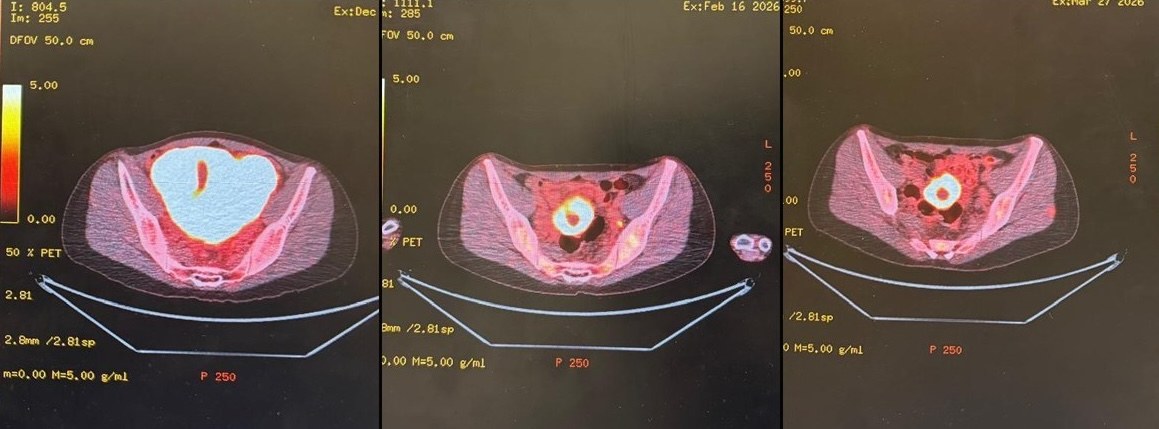
After three rounds, a PET scan. Real progress — the primary tumor had shrunk significantly. But after three rounds, the expectation is near-elimination. Residual metabolic activity was still too high. For the first time, the possibility that chemotherapy might not fully cure her entered the room.
After five rounds, a second PET scan. No further shrinkage. Metabolic activity had actually increased. The chemotherapy had stopped working. Round six was cancelled. A new plan became immediately necessary.
To qualify for the Stanford clinical trial that became her best path forward, Karis had to be classified as refractory — meaning she had failed two chemotherapy regimens. Working with Dr. Joseph Schroers-Martin, her lymphoma oncologist at Stanford, the family identified the most promising path: a clinical trial led by Dr. Saurabh Dahiya. Karis's doctors prescribed a second regimen they knew was unlikely to help. She completed it.
Before her T-cell collection, Karis needed veins strong enough to hold two large-bore needles for hours without collapse. The nursing team failed her on the first check. The doctor told her honestly: he had never in his career seen a patient turn this around in two weeks. She built a daily protocol anyway — water bottle on a trampoline, stress ball, gallons of water — and passed her second vein check with room to spare. She was spared the alternative: sedation and a neck catheter the morning of collection.
Five sessions of radiation, aimed at the remaining tumor. The goal was a 10% reduction in size — enough to stop at six sessions instead of pushing to ten and increasing the long-term risk of secondary cancer. After five sessions, the team measured a 40% reduction. The first decisive piece of good news since diagnosis.
Three days of lymphodepletion chemotherapy — which went far better than she feared — cleared the way for the engineered cells. On June 3 the T-cells were infused: a two-minute procedure she came through with no immediate reaction.
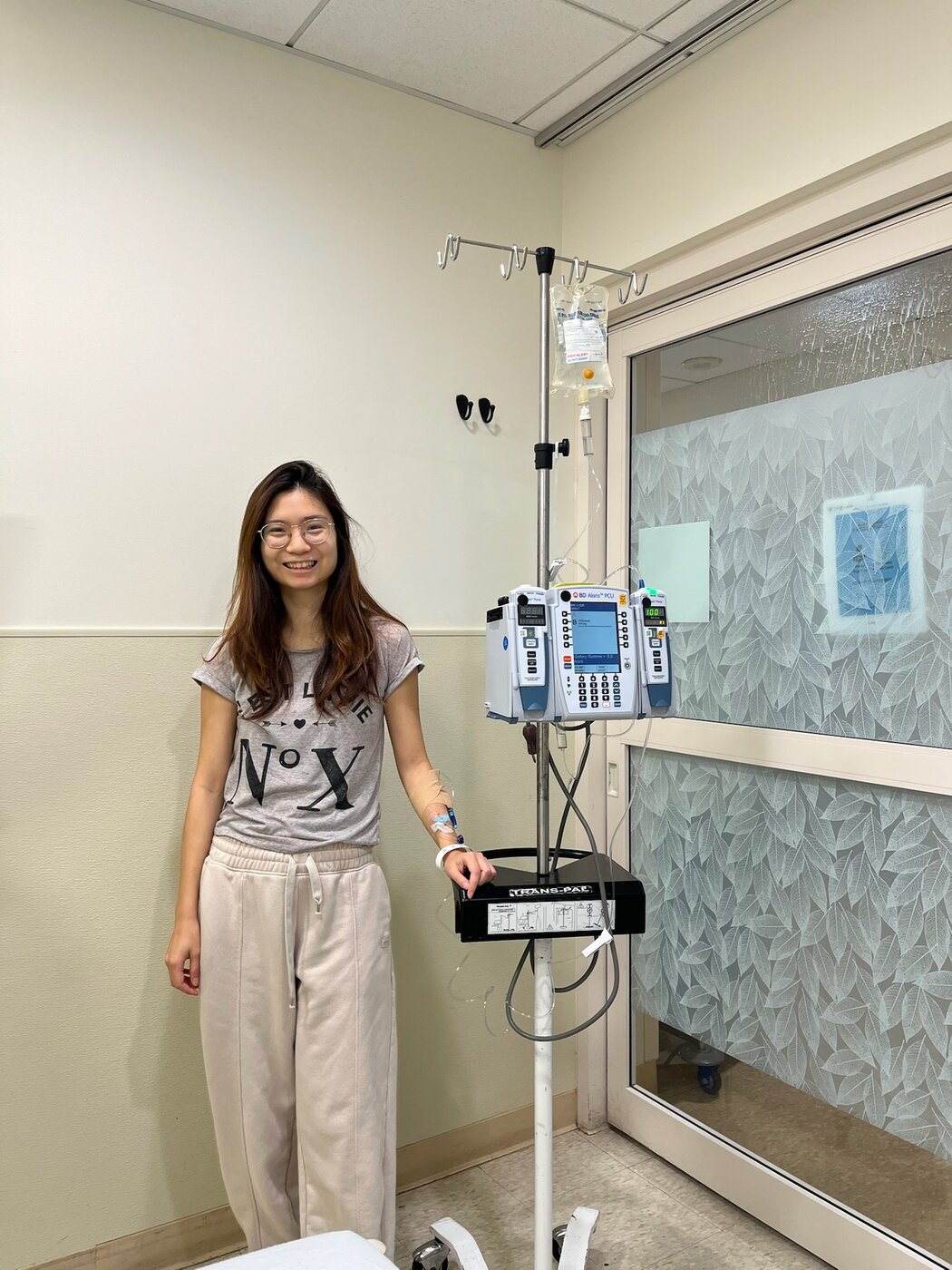
Karis is hospitalized in Stanford's CAR-T and transplant unit for the monitoring window — the highest-risk weeks of the trial, when the team watches closely for the side effects that tend to surface in the days after infusion. She is walking laps of the unit with her IV pole, re-training her lungs, and waiting to see how her body responds.
Then, in May 2026: five sessions of radiation produced a 40% reduction in tumor size — the first decisive piece of good news since diagnosis.
This would have been Karis's odds before the introduction of CAR-T therapy, less than a decade ago.
Karis's odds with FDA-approved CAR-T therapy. A remarkable advance. And yet, imagine being in law school one day and told the next that it is more likely than not you will never be cured. Karis's doctors wanted to explore something with even more hope.
Initial Phase 1 dose-escalation results from KITE-753, Dr. Dahiya's bispecific CAR-T trial at Stanford. Eleven of 14 patients at the highest dose level achieved a complete response — meaning detectable cancer disappeared. The trial targets two tumor receptors simultaneously instead of one. Reported by Kite Pharma at the American Society of Hematology, December 2025. Karis has enrolled.
The bridge therapies and the infusion are behind her. What remains is the four-week monitoring window that will determine whether it worked.
Three consecutive days of chemotherapy to wipe out Karis's existing T-cells, making space for the engineered cells to expand and work. It was the step Karis dreaded most — three days of chemo back-to-back — and it went better than she feared.
The engineered T-cells — harvested during apheresis and modified in the lab to target two cancer receptors simultaneously (CD19 and CD20) — were infused on June 3. Initial Phase 1 results from KITE-753 at the highest dose level showed 11 of 14 patients (79%) achieving a complete response. Karis is one of the first patients at this dose level outside that initial cohort.
Karis is hospitalized at Stanford and monitored every few hours. The two most common serious side effects are CRS (cytokine release syndrome — the immune system overresponding) and ICANS (a neurological syndrome) — the reason for the name checks and the count-backwards tests several times a day. Both are managed when they occur; both can be severe. This is the most critical window of the trial.
The first read of whether the CAR-T worked. In cases where it does not achieve complete response, the majority of patients relapse within three months. Karis has asked for prayer specifically for the months of June through September — and for the Day 28 result itself.
Karis is fighting on two fronts. The first is her body. The second is the life she was carefully building before she got sick.
She started Stanford Law in fall 2025 with a plan. A paid judicial clerkship was lined up for summer 2026. She was on track to graduate and begin the legal-advocacy work she had spent a decade preparing for: worker justice, cancer rights, the disenfranchised communities she set out to serve.
Cancer has dismantled that plan piece by piece. Treatment has made it impossible to graduate on schedule; the clerkship was cancelled; the calendar she had built her life around dissolved. What it could not touch was the work itself — the education, justice, and dignity initiatives she had spent her adult life building for other people.
That is the part of her fight that did not have to pause. Karis decided early that the work she had championed should not stop because she got sick. So she helped shape an institution to carry it forward — one that does not depend on her health, her calendar, or any single person.
The treatment is being handled by her medical team. The life she was building is on hold while she heals. But the mission — the children in Kenya, the workers in Naivasha, the cancer patients who can't navigate the system alone — carries on through The Karis Hope Fund, the public charity her life inspired.
When Karis was diagnosed, the path ahead was hard but bounded — six rounds, a finish line she could fix her eyes on. When the second scan showed the cancer reasserting itself and round six was cancelled, that finish line disappeared. She asked her friends not for strength but for hope.
We want to help her keep her big dreams alive.
The radiation breakthrough in May was the first answer to that prayer.
After five sessions of radiation, the call came: a 40% reduction. The first decisive piece of good news since her diagnosis. She wrote a friend that afternoon:
"I am so grateful for the positive results from radiation. That was a huge relief. And puts me in a muchhhh better prognosis bucket for CAR-T. I was really surprised. Have gotten used to just expecting bad calls!"
Since then, she has come through lymphodepletion and, on June 3, the CAR-T infusion itself. She is now in the hospital for the monitoring window — walking laps of the unit with her IV pole, re-training her lungs, and waiting to see how her body responds. Read her latest letter from the ward →
She is doing what she has always done. Using whatever she has to move the things she cares about forward.
The three days of back-to-back chemo she dreaded most went better than she feared, and she came through the June 3 infusion with no immediate reaction. Two answered.
Particularly CRS — cytokine release syndrome, the immune system overresponding — and ICANS, a neurological syndrome. These are the two most common serious complications. She is hospitalized and monitored every few hours through this window.
A cancer-free PET scan after Day 28, and protection through the three months that follow. Karis has said it plainly: in cases where the CAR-T doesn't work, the majority of people don't survive the year. The worst relapses occur in the first three months — June 3 through September 3 for her. Of the three, this is what she has asked for perhaps most of all.
Karis's treatment is in the hands of her medical team, and her recovery is the fight that matters most right now. What she has asked for is prayer, and that her work continue while she heals.
The education, justice, and dignity initiatives Karis has spent her life championing — Wezesha and TAFA in Kenya, the Worker Justice partnership in Naivasha, Cancer Rights at Stanford — continue through The Karis Hope Fund, a public charity governed by an independent board. Supporting the Fund is the most lasting way to honor what she has given her life to.
Learn about the Fund →